





Gold loans provide immediate financial assistance across India. They allow individuals to leverage their gold assets for quick cash. This secured loan option is popular due to its straightforward process. It involves minimal documentation compared to many unsecured loan types.
The speed of approval for gold loans is a significant advantage. This makes them a preferred choice during urgent financial needs. Borrowers can access funds rapidly without extensive credit checks. Your gold serves as collateral, simplifying the lending process.
Understanding the Gold Loan Mechanism
A gold loan is a specific type of secured loan. Borrowers pledge their gold items to a financial institution. These items can include jewelry, gold coins, or gold bars. In return, the lender provides cash. This cash amount typically ranges from 50% to 90% of the gold's current market value. The purity and weight of the gold determine this valuation.
In India, the lender securely holds the pledged gold. It remains with them throughout the loan tenure. Upon full repayment of the loan, the gold is returned to the borrower. Interest rates on gold loans are influenced by several factors. These include the RBI repo rate, which was around 6.5% in early 2026. The prevailing gold prices in INR also play a crucial role.
Borrowers have flexible repayment options. These include bullet payment, where principal and interest are paid at the end. Alternatively, Equal Monthly Installments (EMIs) are available. Loan tenures typically range from 3 months to 36 months. This flexibility helps borrowers manage their finances effectively.
Key Providers of Gold Loans in India
Many financial institutions offer gold loans in India. Major public sector banks include State Bank of India (SBI). Prominent private sector banks are HDFC Bank, ICICI Bank, Kotak Mahindra Bank, and Axis Bank. These banks offer competitive rates and secure services.
Non-Banking Financial Companies (NBFCs) also hold a significant market share. Muthoot Finance and Manappuram Finance are leading NBFCs. Others include Bajaj Finserv, Shriram Finance, and IIFL Finance. Newer players like Airtel Finance are also entering this space. These NBFCs are known for faster processing and disbursal.
Public sector banks, like SBI, often provide lower interest rates. However, their processing times might be longer. Private banks and NBFCs, on the other hand, offer quicker disbursal. This can happen within hours through their branches or mobile applications. It is important to note that a complete national list is not exhaustive. Many smaller regional players and cooperative banks also operate locally.
LTV and 10g floor — 21 July 2026
RBI allows up to 90% LTV on eligible gold ornaments — Muthoot/Manappuram often lend at top band; SBI/HDFC commonly cap 75–80% with lower APR.
Minimum pledge near 10 grams — below that most branches decline ticket; carry invoice if available for ownership proof.
| Rule | NBFC | Bank | LTV cap |
|---|---|---|---|
| 90% RBI | 75–80% | Min weight | 10g |
| Standard | APR | 12–24% | 8.5–13% |
Verify RBI-regulated lender status and Key Fact Statement (KFS) APR on the day you sign — repo-linked spreads can shift after MPC meetings.
Eligibility Criteria for Gold Loans
To apply for a gold loan, applicants must meet specific criteria. The age requirement is typically between 18 and 70 years. Applicants must also be Indian residents. Valid Know Your Customer (KYC) documents are essential. These include Aadhaar, PAN card, or Voter ID.
The applicant must own the gold being pledged. A minimum weight of 10 grams is often required. The gold's purity should generally be between 18 and 22 carats. Unlike personal loans, a minimum income or CIBIL score is usually not necessary. This makes gold loans highly accessible. They serve salaried individuals, self-employed persons, and farmers alike.
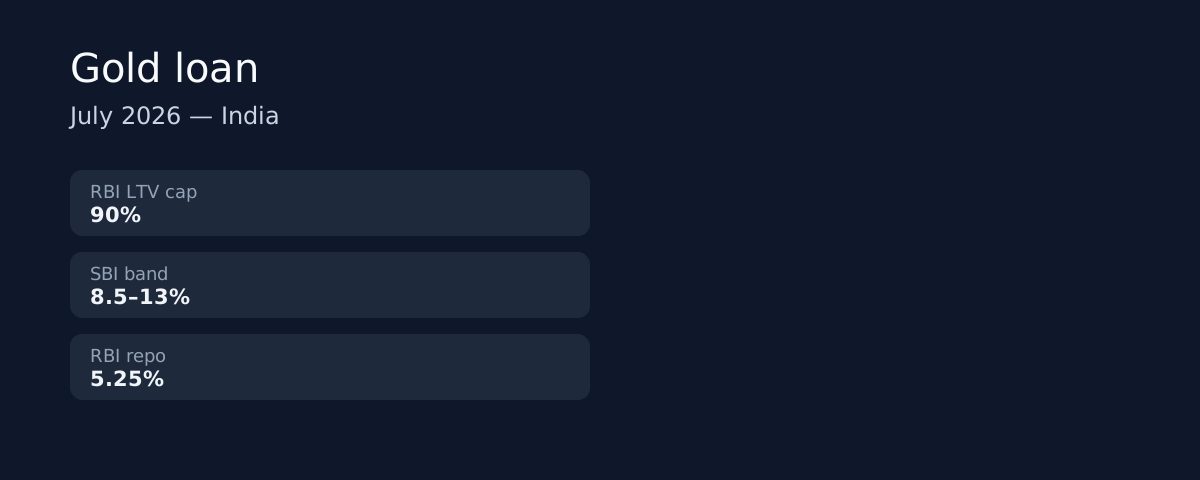
The Reserve Bank of India (RBI) sets regulations for gold loans. The Loan-to-Value (LTV) ratio is capped at 90%. This means the loan amount cannot exceed 90% of the gold's market value. This regulation ensures a safety margin for lenders. It also protects borrowers from excessive debt.
Interest Rates and Comparison
Interest rates for gold loans vary significantly among providers. Public sector banks generally offer lower rates. SBI, for instance, has rates ranging from 8.5% to 13% per annum. Private banks like HDFC Bank and ICICI Bank fall in the 9% to 16% range. These rates often include factors linked to the RBI repo rate.
NBFCs typically charge higher interest rates. Muthoot Finance rates can be 12% to 24% per annum. Manappuram Finance is similar, ranging from 12% to 22%. The trade-off is often faster loan disbursal. NBFCs can process loans in a matter of hours. Banks might take a few days for approval and disbursal. Gold price volatility also impacts these rates.
Processing fees also differ. Banks often charge 0.25% to 1% of the loan amount. NBFCs might have slightly higher fees, sometimes up to 4.85% for certain products. Tenure options also vary. Banks typically offer longer tenures, up to 36 months. NBFCs often focus on shorter terms, sometimes as low as 3 months. It is crucial to compare these factors thoroughly.
| Provider | Interest Rate (p.a.) | Processing Fee | Tenure | Max LTV |
|---|---|---|---|---|
| SBI | 8.5-13% | 0.25-1% | 12-36 mo | 75% |
| HDFC Bank | 9.5-15% | 0.5-1% | 6-24 mo | 75% |
| ICICI Bank | 9-16% | Up to 1% | 12 mo | 80% |
| Kotak Mahindra | 9-14% | 0.5-1% | 6-24 mo | 75% |
| Axis Bank | 9.5-14% | 1% | 12 mo | 80% |
| Muthoot Finance | 12-24% | 0.3-1% | 6-12 mo | 85-90% |
| Manappuram | 12-22% | 0.4% | 3-12 mo | 85% |
| Bajaj Finserv | 9.5-18% | Up to 4.85% | 12 mo | 75% |
The Gold Loan Application Process
The application process for a gold loan is relatively straightforward. It can be initiated either online or offline. First, you need to fill out an application form. This form will request details like the desired loan amount, information about your gold, PAN, and mobile number.
Next, a gold appraisal is conducted. You can visit a branch for this, or some providers offer home visits. A karat meter tests the gold's purity. This step ensures an accurate valuation of your collateral. This appraisal is crucial for determining the eligible loan amount.
After appraisal, you submit your KYC documents. Once verified, you receive a loan sanction letter. You then pledge your gold and sign a loan agreement. Funds are typically disbursed quickly. They can be credited to your bank account via NEFT or UPI, or provided as cash up to ₹20,000.
Repayment must be made on time according to the agreed terms. Once the loan is fully repaid, your pledged gold is returned to you. Many providers now offer doorstep services. Apps like Paytm, Bajaj Finserv, or Airtel Finance facilitate this convenience. This digital transformation simplifies the entire process.
Required Documentation for Gold Loans
Documentation for a gold loan is minimal. The primary requirement is valid KYC proof. Accepted documents include Aadhaar card, PAN card, Voter ID, Passport, or Driving License. These establish your identity and residency.
While not always mandatory, providing the gold receipt or invoice can be helpful. This helps confirm ownership and origin. Rarely, for larger loan amounts, lenders might request photographs or bank statements. However, these are not standard requirements for most gold loans. Crucially, income proof is usually not needed. This makes gold loans accessible to a wider demographic. The gold itself acts as sufficient security.
Advantages and Risks of Gold Loans
Gold loans offer several compelling advantages. They provide quick disbursal, often within 30 minutes to 2 days. Interest rates are generally lower compared to unsecured personal loans, often tied to the RBI repo rate. A significant benefit is that no credit check is typically required. The funds can be used for any purpose, and the interest paid might be tax-deductible under certain conditions. Your gold remains safe with the lender in secure vaults.
However, gold loans also come with risks. The most significant risk is the auction of your gold if you default on payments. Lenders can auction the gold after a 12-month notice period. High renewal fees can accumulate if the loan is extended repeatedly. Purity disputes can arise during appraisal. A drop in gold prices might lead to a lower Loan-to-Value (LTV) upon renewal. Borrowers should compare LTV and tenure carefully. It is wise to monitor INR gold rates, which were around ₹75,000/10g in 2026. Considering gold insurance for the pledged asset is also a prudent step.
Advantages
- Quick disbursal (30 mins-2 days)
- Lower interest rates than personal loans
- No credit score check required
- Flexible usage of funds
- Gold is kept safe with lender
- Minimal documentation
Disadvantages
- Gold auction if loan defaults
- Potential for high renewal fees
- Risk of purity disputes
- LTV can drop if gold prices fall
- Requires physical gold collateral
- Non-return of gold upon default
Regulations and Market Trends
The RBI plays a critical role in regulating gold loans. It caps the LTV at 90% to manage risk. The RBI mandates that lenders can only auction pledged gold after a 12-month default period. Unlike bank deposits, gold held as collateral is not covered by DICGC insurance. This highlights the importance of timely repayment. The RBI repo rate directly influences the base lending rates for gold loans.
As of March 2026, the gold loan market is experiencing growth. This is partly due to a surge in gold prices, which were up 15% year-on-year in INR terms. This makes gold a more valuable asset for collateral. A significant trend is the rise of digital pledging. Fintech companies are pushing for online and app-based services. This enhances convenience and accessibility for borrowers across India.
Expert Tips for Gold Loan Borrowers
Choosing the right gold loan provider is key. For lower interest rates, consider public and private banks. Their rates are often below 12%. If speed of disbursal is your priority, NBFCs are a better choice. Always use an EMI calculator to understand your repayment schedule. Pledge only the exact amount of gold needed for your loan. This minimizes your risk exposure.
It is advisable to renew your loan early if needed. This helps avoid late fees and potential auctions. Keep a close eye on the RBI website for any changes in repo rates. These changes can impact your loan's interest rate. Explore hybrid repayment options, such as part EMI and part bullet payment. These can help manage interest costs. Avoid taking a gold loan if you anticipate a significant drop in gold prices. Such a drop could lead to a higher effective LTV.
Gold loan — July 2026
July 2026 update: gold loans against 18–22K jewellery remain the fastest secured route — ₹10,000 to ₹50 lakh+ at 50–90% LTV (RBI cap 90% on eligible ornaments) from SBI, HDFC, ICICI, Muthoot, Manappuram. PSU banks often quote ~8.5–13% p.a.; NBFCs ~12–24% for same-day disbursal. RBI June 2026 MPC held repo at 5.25%.
Tenures typically 3–36 months with bullet or EMI repayment; processing 0.25–1% at banks versus up to ~1% at NBFCs. Minimum pledge often 10g gold — karat meter appraisal at branch or doorstep. CIBIL usually not required; overdue risks auction of pledged gold per sanction letter.
| Provider | Rate band | LTV | July 2026 |
|---|---|---|---|
| SBI / PSU | ~8.5–13% | Up to 75% | Lower cost |
| HDFC / ICICI | ~9–16% | 75–80% | Branch/app |
| Muthoot / Manappuram | ~12–24% | Up to 90% | Fastest |
| RBI repo | 5.25% hold | LTV cap 90% | June 2026 MPC |
Compare total rupee cost including valuation fee + renewal if you roll bullet loans — NBFC speed has a price on identical 20g pledge.
Before you accept
Compare total rupee cost (APR in KFS), not only EMI — processing fees and insurance add to effective rate.
Reject apps that disburse to third-party wallets; legitimate RBI lenders credit your own bank account.
Match tenure to need — do not stretch short-term expenses over 5 years.
Check CIBIL before applying; recent delinquencies block even app-based approvals.